
Key Takeaways
- Urban demolitions demand careful planning to address safety, environmental impact, and community concerns.
- Selective demolition and material recovery are essential for sustainable practices.
- Advancements in electric machinery and precision tools enhance efficiency and reduce environmental footprint.
As cities grow and evolve, demolition in urban settings becomes an essential part of the development process. Removing outdated or unsafe buildings makes way for new construction, but it also introduces challenges specific to the dense, vibrant environments of cities. Urban demolition projects require a blend of strategic planning, strong safety protocols, and respect for the surrounding community.
The complexity of urban demolition arises from the proximity to occupied buildings, bustling pedestrian traffic, and the need to comply with stringent regulations. These factors mean that any misstep can have far-reaching consequences, so comprehensive risk management is a top priority at every stage of the project.
Additionally, the goal in urban demolition is no longer simply to tear down and haul away. Rather, it is to achieve a carefully controlled process that minimizes disruption to city life while producing as little waste as possible. This shift has given rise to selective demolition techniques, which focus on recovering materials and supporting recycling initiatives.
Urban redevelopment often includes groundwork that sets the stage for new buildings. Partnering demolition efforts with Grading And Excavating services helps prepare the land for future use in a sustainable, efficient manner.
Understanding Urban Demolition Challenges
Demolishing structures in a city environment is different from other demolition scenarios due to the presence of adjacent infrastructure, public safety concerns, and limited working space. Each project requires a tailored approach based on the specific site constraints, with expert teams conducting thorough risk assessments before work begins. Even the most routine demolition in an urban area can pose a risk of collateral damage, underscoring the importance of specialized planning and oversight.
Local governments frequently impose strict operational schedules and noise restrictions to minimize impacts on residents and businesses. Any project must also account for traffic flow adjustments and pedestrian rerouting to maintain public safety throughout the process. For more insights into urban construction policies, visit the New York Times coverage on demolition regulations.
Planning and Safety Measures
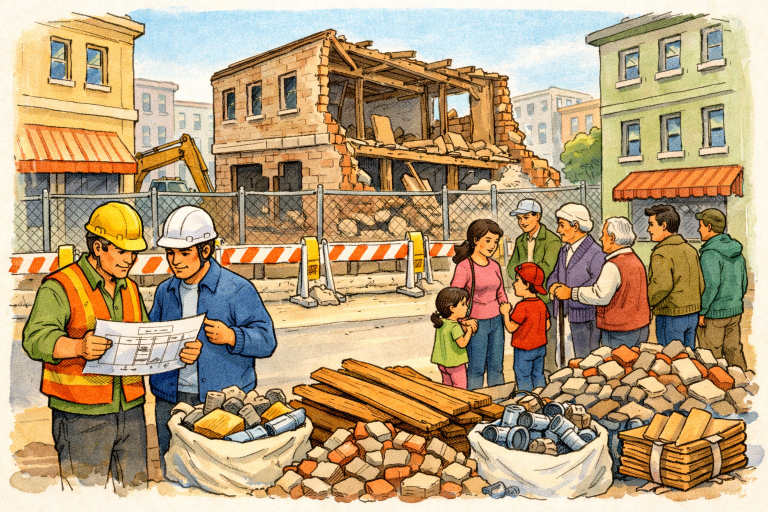
A successful urban demolition project starts with extensive planning. This includes conducting structural assessments to determine the safest removal method for each segment of the building and securing necessary permits from local authorities. Equally important is establishing open communication with the local community. Informing residents and nearby businesses about the demolition schedule, noise mitigation steps, and expected traffic adjustments increases public trust and reduces dissatisfaction.
- Structural Assessments: Evaluating the existing building for stability and identifying nearby utilities and infrastructure at risk.
- Permitting: Ensuring every phase of the demolition complies with city regulations, including specific requirements for waste disposal and environmental protection.
- Community Communication: Providing regular updates and direct contact points for community feedback or concerns.
Thorough preparation also anticipates the need for rapid response should site conditions change, ensuring teams are equipped to manage emergencies such as partial collapses or environmental hazards.
Selective Demolition and Material Recovery
Selective demolition is the process of carefully dismantling portions of a structure to salvage valuable materials for reuse and recycling. This approach is increasingly common in urban settings as cities aim to reduce landfill contributions and embrace the principles of a circular economy. Recoverable materials often include steel, concrete, bricks, and architectural features that can be integrated into new builds or repurposed in other projects.
Effective material recovery strategies require specialized training for crews and the use of precise tools that minimize contamination or damage to reusable components. Larger trends in green building standards and urban resource management support these sustainable practices. For a broader look at how cities manage demolition debris, see the Forbes article on demolition waste management.
Innovative Technologies in Demolition
The demolition sector is transforming with the introduction of advanced machinery and new methods for monitoring and controlling each step of the process. Electric demolition equipment, such as cranes and excavators powered by renewable energy, eliminates on-site emissions and reduces noise compared to traditional machinery. Automation and remote-control systems improve worker safety, especially when working with hazardous structures or in confined spaces.
Sensor technology and digital project management tools also offer new levels of precision in execution. These technologies allow teams to monitor building integrity in real time, improving project timelines and enhancing environmental controls during the dismantling phase.
Environmental Considerations
Environmental protection is a guiding principle throughout any urban demolition project. Dust and debris management come to the forefront, particularly in densely populated areas where airborne particles can affect public health. Water spraying systems and protective barriers are commonly used to contain dust. Additionally, sound barriers and adaptive scheduling help maintain a livable environment for neighboring buildings and residents.
Responsible waste handling means all demolition debris is sorted and hazardous materials are disposed of in accordance with local and federal guidelines. Projects that fall short of these expectations may face public pushback or regulatory shutdowns, such as the notable halt of the Damen Silos demolition in Chicago due to excessive dust emissions.
Case Studies of Successful Urban Demolitions
Grays Ferry Parking Garage, Philadelphia
The Grays Ferry Parking Garage, which suffered a partial collapse, required a controlled demolition to ensure the safety-compromised structure posed no danger to the surrounding area. The team tightly coordinated every aspect of the process, demonstrating how clear communication and ongoing risk assessment reduce the likelihood of incident or injury.
Sawyer Towers, Columbus
At the Sawyer Towers site in Columbus, the demolition of condemned apartment buildings became a community-focused effort. Contractors prioritized ongoing dialogue with residents, took environmental precautions to limit disruption, and integrated recovered materials into city improvement projects. This model shows how effective urban demolition can foster positive neighborhood transformation.
Conclusion
Urban demolition requires a highly strategic and responsible approach. By prioritizing safety, leveraging the latest technology, and emphasizing sustainable practices like selective demolition and robust community engagement, developers can achieve outcomes that benefit both the city’s infrastructure and its residents. For anyone planning or considering a city demolition project, staying informed of best practices ensures not only compliance with regulations but also fosters healthier, more sustainable urban environments.