
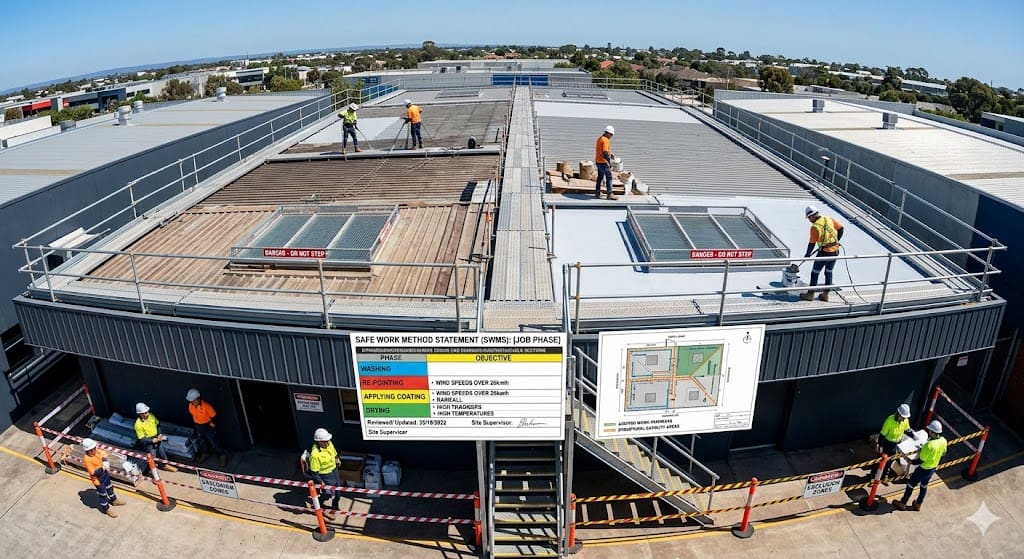
Safety measures to plan roof construction often prioritize using harnesses. A manager visits the construction site, identifies any unprotected edges, and incorporates lanyards into the plan. This satisfies the paperwork, but it ignores the Hierarchy of Control, which on a restoration site, disproportionately invites fatalities. Falls from heights continue to generate between 11% and 15% of all dangerous construction work each year. This hasn’t changed a lot because many jobsites continue to rely on personal protective equipment as the principal control measure.
The Problem With Relying On Harnesses As Your Primary Plan
Harnesses are effective only if all the components involved work correctly – if the lanyard and anchor point are certified, the lanyard is the appropriate length, the operator connects every time, and a rescue plan is immediately available whenever a fall occurs. There are many conditions to ensure safety in the use of harnesses. In a restoration task where workmen are constantly moving above the roof, pulling equipment, changing location, and switching between duties, compliance with harness systems decreases significantly. The Hierarchy of Control is intended to assist in minimizing the reliance on those conditions. The top of the hierarchy is the elimination. Below this level are engineering controls – physical systems that minimize the risk to the operator regardless of their actions. Enclosure Protection is a system located directly below the engineering level, and it must be the priority for a Construction Manager planning a recovery task, not the alternative.
Start With A Structural Integrity Audit
Prior to starting any job, the first step in the process is ensuring the safety of the workers who are there to do the work. Some roofs need walkboards or mesh to prevent falls through skylights or unprotected edges. Other roofs not designed to carry loads will need to be accessed from elevated work platforms. Then there are roofs where a combination of walkboards, travel restraint anchors, exclusion zones, bitumen spark-arrestors, and scissor lifts are all deployed to keep workers productive and safe.
Non-compliant equipment rental organizations offering one-size-fits-all solutions for these variables are rolling the dice with lives. Every decision must be justified and based on the audit of the roof substrate, supporting structures, and workplace activity. This is where full-service contractors shine; they don’t just front up the capital for specialized equipment, but their engineers provide the structural sign-offs too.
Engineer The Perimeter Before You Start The Work
After the structural audit is done, we start with perimeter protection before any restoration work starts. By installing roof handrail systems around the perimeter and you get a passive barrier that protects everyone on the roof at the same time – no thinking about it required for any worker near the edge.
This specifically counts on restoration jobs because the work constantly changes the surface conditions. High-pressure washing wets it. Re-pointing involves debris. Painting distracts. If you’ve got a static line and harness setup then the worker is managing their own restraint while doing all of that. The worker can still move freely, carry materials, work at pace, and the protection is still there. That’s not just safer – it’s measurably better for productivity on labor-intensive tasks.
Build A SWMS That Reflects How The Job Actually Changes
A Safe Work Method Statement for a restoration job cannot see the whole job as a single task. The hazard profile shifts constantly. The SWMS needs to explicitly map each phase – washing, drying, application, inspection – and define the control measures that apply to each.
When surfaces are wet, wet-weather protocols apply. When workers are moving from washing to painting, the transition itself needs a procedure. When wind picks up, there has to be a defined threshold – not a supervisor’s judgment call but an objective number. Many site managers use 28 km/h as the wind speed trigger for stopping roof work entirely. Temperature thresholds for heat risk and rain triggers for slip risk should appear in the same document.
The Working at Heights Association (WAHA) recommends that SWMS documents for high-risk work be reviewed and updated when conditions change, not just at the start of the job. On a restoration site, that means a dynamic document that workers and supervisors can reference when a task shifts.
Lock Down The Tool and Ground Control Protocols
Objects in free fall pose a different compliance problem to those falling whilst being used by workers – and similarly, it’s 100 per cent preventable. Tool tethering, debris netting or sheeting under the work area, and exclusion zones that are clearly barricaded at ground level are considered the “go-to minimum” options. This is non-negotiable and the exclusion zone is not a mere recommendation, it must be physically marked and implemented. Ground workers and passing site workers can’t be left to manage their own exposure to the work above.
All of this should be explicitly covered during an on-site induction attended by every subcontractor coming onto the site. Tool box talks in a lunchroom just won’t cover it and the objective is for the worker to understand the peculiar risks of the particular site they’re walking onto.
Common sense trumps all. Roofing jobs are complex, and it is the role of the works to itemise and manage that complexity through proper planning and engineering – not through each individual’s compliance with their PPE obligations.