
Strong strokes begin long before speed becomes a goal. Shoulder discomfort often develops from small technique errors repeated hundreds of times rather than from a single event. Quality swimming lessons help swimmers build efficient movement patterns that protect joints, improve endurance, and make time in the pool more enjoyable.
Proper Hand Entry Mechanics That Reduce Excessive Shoulder Joint Stress
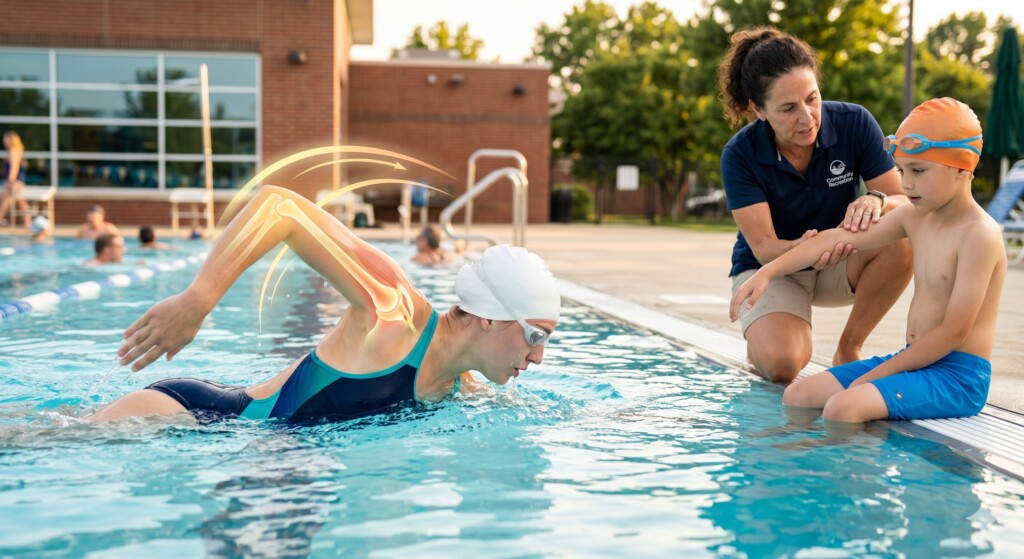
Many shoulder problems begin at the moment the hand enters the pool. Crossing the arm too far across the body’s centerline places unnecessary strain on the shoulder joint and forces muscles to work from awkward positions that can gradually lead to irritation.
Correct technique keeps the hand entering in line with the shoulder while maintaining a relaxed recovery phase. During swimming lessons in Springfield, VA, instructors often focus on this detail because a cleaner entry position helps create smoother strokes while reducing repetitive stress that can accumulate over weeks and months of practice.
Maintaining Balanced Rotational Body Position Throughout Freestyle Stroke Cycles
Freestyle depends on body rotation as much as arm movement. Swimmers who remain flat in the pool often compensate by placing extra workload on their shoulders, causing muscles to work harder than necessary during every stroke.
Efficient rotation distributes effort across the entire body instead of concentrating force in a single joint. Springfield, VA swimming lessons frequently teach swimmers how to rotate through the hips and torso, allowing larger muscle groups to contribute to propulsion while easing the burden placed on the shoulders.
How Early Stroke Correction Prevents Repetitive Overuse Movement Patterns
Small flaws rarely cause immediate pain. Reaching incorrectly, pulling too wide, or dropping the elbow may feel harmless during a short session, but those movements can repeat thousands of times throughout a season of training.
Early correction helps prevent those habits from becoming deeply ingrained. Professional swimming lessons emphasize technique development before speed, giving swimmers a chance to build efficient movement patterns that support long-term comfort and performance.
Developing Efficient Catch and Pull Techniques for Better Force Distribution
Powerful swimming is not about pulling harder. Generating propulsion comes from directing force effectively through the water while maintaining proper alignment between the hand, forearm, shoulder, and torso.
An efficient catch position allows swimmers to engage larger muscle groups in the back and core. Swimming classes near me often prioritize these skills because proper force distribution reduces unnecessary shoulder strain while improving stroke efficiency and forward momentum.
Why Head Position Directly Influences Shoulder and Upper Back Mechanics
Head placement affects much more than breathing. Looking too far forward or lifting the head excessively can alter body alignment and create tension that travels through the neck, shoulders, and upper back.
Balanced posture helps keep the entire stroke connected and efficient. Many participants in swimming lessons near me are surprised to learn that a simple adjustment in head position can reduce strain while making swimming feel smoother and less physically demanding.
Building Shoulder Stability Through Controlled Technique and Muscle Engagement
Healthy shoulders rely on stability as much as strength. Small stabilizing muscles help guide joint movement and keep the shoulder functioning properly throughout repeated arm cycles.
Structured instruction teaches swimmers how to engage supporting muscles without creating excessive tension. Proper technique encourages balanced movement patterns that help protect the shoulder complex while supporting stronger, more controlled strokes.
Understanding How Fatigue Contributes to Form Breakdown and Injury Risk
Technique often changes when swimmers become tired. Elbows may drop, body position may deteriorate, and stroke timing can become less consistent as fatigue develops during longer training sessions.
Recognizing those changes allows swimmers to make corrections before discomfort appears. Swimming lessons in Springfield, VA frequently emphasize awareness of body mechanics so swimmers can identify technique breakdowns and maintain safer movement patterns during extended practice.
The Connection Between Breathing Technique and Shoulder Movement Efficiency
Breathing influences rhythm, balance, and body position. Poor breathing habits often cause swimmers to twist excessively, lift their heads too high, or alter arm mechanics in ways that place added stress on the shoulders.
Consistent breathing technique supports smoother stroke execution. Experienced instructors help swimmers coordinate breathing with body rotation, creating a more natural movement pattern that improves efficiency while reducing strain throughout the upper body.
Why Professional Instruction Helps Swimmers Identify Hidden Technique Errors
Many stroke flaws are difficult to recognize without outside feedback. Swimmers may feel comfortable in the pool while unknowingly repeating movements that increase injury risk and limit performance improvements.
Professional coaching provides valuable perspective that self-correction often cannot match. SafeSplash provides individualized instruction that helps swimmers recognize technique issues early, reducing the likelihood of developing chronic discomfort caused by repetitive stroke errors. Many families and adults seeking swimming lessons in Springfield, VA choose structured coaching to build stronger fundamentals and more efficient swimming habits.