
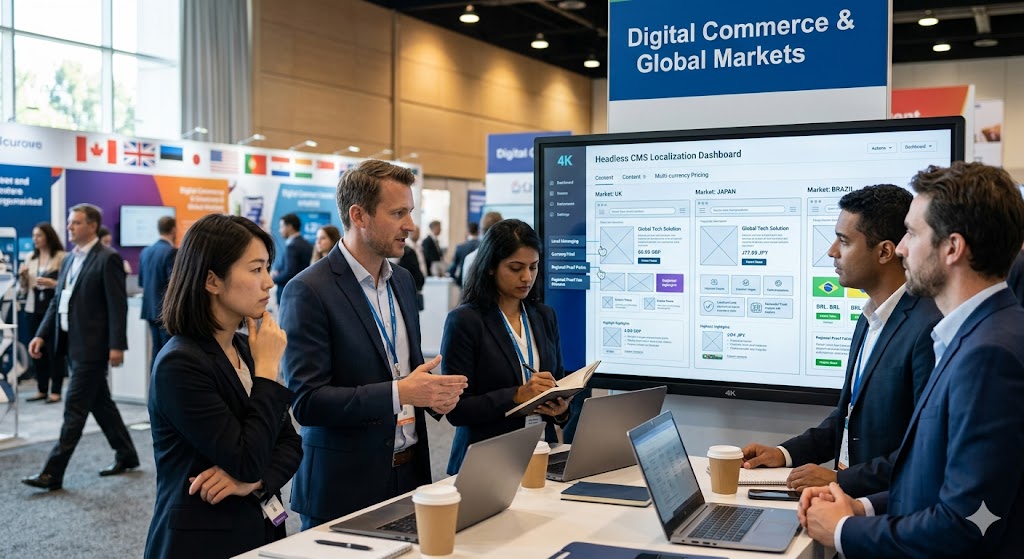
Expanding into multiple markets changes the role content plays in a business. It is no longer enough to publish a single version of a product page, service description, or campaign message and expect it to work everywhere. Different regions often require different currencies, localized pricing logic, region-specific offers, distinct promotional language, and adjustments based on local buying behavior. Even when the core brand remains the same, the way value is presented often needs to shift from one market to another. If businesses cannot manage these differences efficiently, they risk creating inconsistent customer experiences, slower internal workflows, and missed conversion opportunities.
A headless CMS provides a stronger foundation for handling this complexity. By separating content from presentation and managing it in a structured way, it allows businesses to support multiple currencies and market-specific content needs without duplicating every page or campaign asset from scratch. This is especially important for international growth, where consistency and flexibility must exist together. A company may want one global product narrative, but it also needs the ability to show the right currency, highlight region-specific proof points, and adapt key messages for different audiences. Headless CMS makes that possible by turning content into a reusable and adaptable system rather than a collection of isolated regional files.
Why Multi-Currency and Market-Specific Strategy Matters in Global Growth
When businesses enter new markets, pricing and messaging become closely connected. Currency is not just a financial detail. It affects how buyers interpret value, compare offers, and judge whether a product feels relevant to their market. Storyblok and Vue can help teams create flexible localized experiences where pricing information, regional messaging, and market-specific content can be managed more efficiently across different digital touchpoints. A visitor in the United Kingdom, for example, expects to see prices that reflect local currency and local commercial logic, not simply a converted number copied from another region. In the same way, a buyer in another market may respond better to different examples, trust signals, or feature emphasis depending on the local business environment. If these expectations are ignored, the experience quickly feels imported rather than intentionally designed.
This is why multi-currency and market-specific content strategy matters so much for expansion. Buyers tend to trust businesses more when pricing feels familiar and the surrounding content feels appropriate to their context. Without that alignment, even a strong product can appear less credible or less convenient than it actually is. A headless CMS helps businesses address this by making it easier to manage both shared global content and localized market layers. Rather than forcing one generic experience across every region, companies can create more relevant journeys while still maintaining overall brand control. That balance is essential for organizations that want to grow internationally without losing clarity or efficiency.
What Makes Headless CMS Well Suited for International Content Needs
A headless CMS is especially valuable for international content strategy because it treats content as structured information rather than fixed page output. In a traditional setup, content is often built directly into page templates or market-specific sites, which makes reuse difficult and updates slow. Once businesses need to manage multiple currencies, multiple regions, and multiple localized versions of similar assets, that structure starts to create friction. Teams end up copying pages, editing them manually, and maintaining many overlapping versions of the same material. Over time, this makes consistency much harder to protect.
With a headless CMS, content can be stored centrally in reusable components such as product descriptions, pricing labels, benefit statements, currency fields, localized offers, market tags, and region-specific calls to action. These elements can then be delivered across websites, apps, landing pages, and other touchpoints through APIs. This matters because international growth depends on flexibility. Businesses need to show different information in different contexts without rebuilding their whole content operation for every market. A headless CMS makes this far more realistic. It allows teams to manage one structured content foundation while adapting presentation and market logic according to where the buyer is and what that market requires.
Managing Currency as Part of the Content Experience
Currency is often handled as a technical or ecommerce issue, but it also plays a major role in content experience. The way price appears on a page influences how buyers interpret the surrounding message. A price displayed in the wrong currency can create hesitation immediately, even if the rest of the content is strong. It can make the offer feel distant, unclear, or not fully available to the visitor’s region. In contrast, when pricing appears in the expected currency and fits naturally into the content around it, the experience feels more trustworthy and easier to act on.
A headless CMS supports this by allowing currency-related fields and pricing logic to exist within a structured content model. This means pricing presentation can be linked more cleanly to market-specific pages, campaigns, and product information. Instead of hardcoding prices into duplicated local pages, businesses can create more flexible systems where the correct currency is delivered according to market rules or user context. This reduces the maintenance burden and improves accuracy across regions. It also helps pricing feel like a natural part of the content journey rather than a disconnected technical element. For businesses operating internationally, that kind of coherence can improve both trust and conversion quality.
Supporting Market-Specific Messaging Without Losing Brand Consistency
One of the biggest international content challenges is adapting messaging for local markets without weakening the overall brand. Different markets often respond to different types of language, proof, urgency, and value framing. In one region, buyers may be motivated by efficiency and cost control. In another, reliability or service quality may carry more weight. If businesses ignore these differences, the content may feel too generic to perform well. But if they create completely separate messaging systems in every market, the brand can lose consistency and become harder to manage.
A headless CMS helps solve this by allowing businesses to keep core brand and product content centralized while layering in market-specific variations where needed. The central message can remain stable, but supporting headlines, region-specific proof points, offer language, or conversion prompts can be adapted based on the market. This creates a much healthier balance between control and flexibility. Global teams can protect strategic messaging, while local teams can shape content to fit their market realities more effectively. That structure is particularly important for companies that want to expand without turning each market into an isolated content operation. Consistency stays strong, but relevance becomes much easier to achieve.
Reducing Duplication Across Regional Pages and Campaigns
A common problem in international content operations is duplication. Once businesses begin creating separate regional pages for different currencies and market messages, the number of assets grows quickly. A product page becomes several product pages. A campaign landing page becomes many versions of the same campaign. A regional pricing offer is copied into multiple environments. At first, this may seem manageable, but the burden grows with every update. Even a small change to a product description or promotion can require manual edits across many duplicated assets.
Headless CMS reduces this duplication because it allows shared content to be reused while still supporting market-specific differences. Instead of cloning full pages for each region, businesses can work with modular content components and structured data fields. A single product narrative can support multiple markets, while local pricing, currency labels, testimonials, or calls to action are inserted dynamically where they belong. This makes international content operations much more sustainable. Teams spend less time rebuilding the same content and more time improving the parts that actually need local relevance. Over time, this creates a stronger and more efficient system for managing both scale and complexity across international markets.
Improving Pricing Accuracy and Update Speed Across Markets
Pricing can change often, especially in businesses with promotions, regional campaigns, subscription adjustments, or exchange-related pricing strategies. In a fragmented content environment, updating these changes across multiple markets can become slow and risky. One region may reflect the new pricing quickly while another still shows old information. A campaign page may be updated while a related product page remains outdated. This kind of inconsistency creates confusion for buyers and makes the business appear less coordinated than it really is. In international markets, those gaps can be especially damaging because trust is already being built across geographic and cultural distance.
A headless CMS improves this situation by making it easier to connect pricing changes to a structured central content system. When pricing elements and market-specific content rules are managed more centrally, updates can happen faster and be distributed more reliably across the touchpoints that depend on them. This does not mean every region has to show exactly the same commercial structure, but it does mean changes can be managed with greater control. Accuracy matters because pricing is one of the most sensitive parts of the buyer journey. When buyers see clear, current, and market-appropriate pricing, the content around that price becomes easier to trust and easier to act on.
Enabling Better Localization Around Currency and Commercial Context
Localization is not only about translating language. It also includes making sure the commercial experience makes sense in the target market. Currency is part of that, but so are tax expectations, promotional framing, payment assumptions, offer structure, and even the way value is described around the price. A piece of content that works well in one market may feel incomplete in another if these factors are not considered. A buyer does not only evaluate the product. They evaluate whether the business seems prepared to serve their region properly.
Headless CMS supports better localization by allowing these commercial details to be structured alongside core content rather than treated as last-minute manual edits. Teams can define region-aware content elements that support local pricing presentation, promotional language, and market-specific context without breaking the overall content system. This makes localization more scalable and more accurate. Instead of translating a fixed page and then manually adjusting scattered commercial details, the business can build those details into the content model itself. That leads to stronger regional experiences because local buyers see content that feels intentionally shaped for their market rather than simply translated from a default global version.
Strengthening Collaboration Between Global and Regional Teams
International content strategy often succeeds or fails based on how well global and regional teams work together. Global teams typically focus on brand consistency, governance, and reusable content systems. Regional teams focus on market relevance, local campaigns, and content that reflects actual buyer expectations. When the content system is weak, these priorities can clash. Global teams may feel regional versions are drifting too far from the brand, while local teams may feel the central content does not reflect how their market actually buys. This tension becomes even stronger when currency and pricing presentation also vary by region.
A headless CMS helps reduce that friction by giving both teams a clearer shared structure. Global teams can define central product content, core messages, and reusable frameworks, while regional teams can manage approved local adaptations within those boundaries. This makes collaboration more practical because the system itself supports both shared control and market-level variation. It also improves update workflows. If the central product story changes, regional content can stay connected to that change without each market starting over manually. That kind of operational clarity is important for international businesses because strong collaboration is rarely achieved through meetings alone. It usually depends on having a content model that supports aligned work in everyday practice.
Supporting Omnichannel Market-Specific Experiences
Modern international businesses rarely serve buyers through one website alone. Buyers may interact through ecommerce pages, campaign landing pages, mobile apps, partner portals, customer dashboards, and email journeys. This means multi-currency and market-specific content strategies must extend beyond one channel. If pricing and messaging are localized on the website but not in the app or campaign experience, the buyer journey still feels fragmented. The business may appear inconsistent even if each individual team has done its work correctly. That is why omnichannel coordination matters so much in international expansion.
Headless CMS is particularly strong here because it is built for distributing structured content across many frontends. Currency logic, market-specific content fields, and localized messaging components can support multiple channels without requiring separate content systems for each one. This helps businesses create more connected international experiences where the same product story and regional relevance carry across the full journey. Buyers benefit because the transition between channels feels smoother and more trustworthy. Teams benefit because they are not forced to manage separate regional content silos for every platform. For organizations expanding internationally, this kind of omnichannel consistency can become a major commercial advantage.