Key Takeaways
- The right neighborhood should support daily routines, financial comfort, and future plans.
- Purchase price is only one cost. Taxes, insurance, fees, maintenance, and repairs also matter.
- Flood exposure, drainage, roof condition, storm protection, and insurance estimates deserve early attention.
- HOA and condominium documents can reveal restrictions, reserve concerns, and potential assessments.
- Multiple visits at different times provide a clearer view than one showing.
Choosing a home in Palm Beach County is also a choice about how each day will work. From waterfront streets and walkable downtown blocks to gated communities and newer suburban developments, buyers should compare more than bedrooms, finishes, and list prices. West Palm Beach FL real estate expert David Cooke leads The Cooke Group, a Palm Beach County real estate team whose website offers buyer and seller guidance, property searches, neighborhood information, and valuation resources for communities including West Palm Beach, Jupiter, Palm Beach Gardens, and nearby areas.
A practical scorecard helps keep that comparison grounded. It can reveal when a home with a lower purchase price carries higher recurring costs, when a beautiful street leads to an inconvenient commute, or when a community’s rules do not support how a buyer plans to live.
Start With Daily Life, Not Listings
Before touring homes, separate must-haves from preferences. Consider travel time to work, schools, medical care, family, the airport, and major roads. Then consider the lifestyle details that shape ordinary weeks: beach access, boating, parks, restaurants, golf, arts, shopping, pet space, guest rooms, storage, and outdoor entertaining.
Also decide whether the home will be a full-time residence, a seasonal retreat, or a property that may be rented later. A neighborhood can be appealing in a listing photo yet feel very different when parking, traffic, walkability, noise, and daily errands are factored in.
Compare Palm Beach County Neighborhood Types
Coastal and Waterfront Areas
Water access, views, and proximity to the beach can be meaningful advantages, but buyers should look beyond the view. Salt air, docks, seawalls, drainage, elevation, roof condition, shutters or impact glass, and storm preparation can affect upkeep and insurance. Review the individual parcel through the FEMA Flood Map Service Center rather than assuming every property in the same city has the same flood considerations.
Downtown and Walkable Areas
Downtown West Palm Beach, Delray Beach, Boca Raton, and similar settings can place dining, shopping, offices, and cultural activities within close proximity. The trade-off may include smaller lots, parking limitations, traffic, construction activity, and changing noise levels. Visit on a weekday, a weekend, and after dark before deciding whether the energy fits your routine.
Established, Gated, and Newer Communities
Established neighborhoods may offer mature landscaping, larger lots, and a distinct street character. Gated or amenity-focused communities can provide recreation, maintained common areas, and controlled access, but may also involve association dues, club requirements, transfer fees, and detailed rules. New-construction areas may offer current layouts, warranties, and newer systems, while buyers should still ask about future building phases, construction traffic, and the developer’s planned amenities.
Build a Simple Neighborhood Scorecard
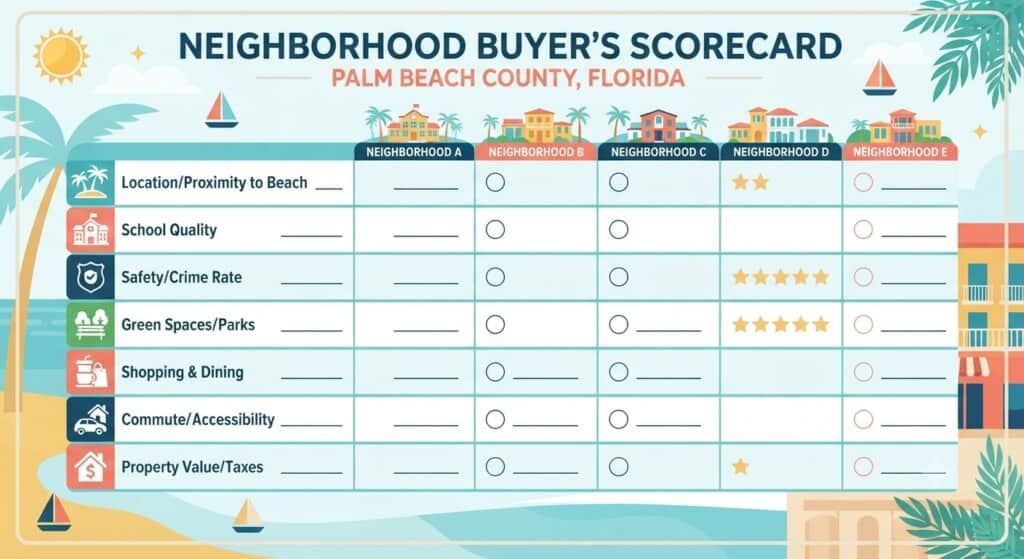
Rate each finalist neighborhood from one to five in the same categories. Use written notes so a memorable kitchen or water view does not overshadow practical concerns.
- Location: Is the area convenient for work, healthcare, travel, errands, and family?
- Lifestyle: Does it match your preferred pace, activities, privacy level, and social environment?
- Monthly cost: Can you comfortably carry the mortgage, taxes, insurance, utilities, and community fees?
- Property condition: What do the roof, HVAC, plumbing, electrical systems, windows, and drainage suggest about near-term work?
- Rules: Are pets, rentals, parking, guests, renovations, and home-based work compatible with your plans?
- Flexibility and resale: Would the home still work if household needs, work arrangements, or plans change?
Calculate the Full Cost of Ownership
Compare complete monthly and annual costs, not just the purchase price. Include principal and interest, estimated property taxes, homeowners insurance, wind and flood coverage where appropriate, association or club fees, utilities, landscaping, pool care, pest control, and anticipated maintenance.
For example, a lower-priced condominium with substantial association dues may cost more each month than a higher-priced single-family home with no association fee. Condo buyers should also identify what the association maintains and what remains the owner’s responsibility. Closing costs, inspections, surveys, repairs, and moving expenses should be included in the initial budget.
Review Insurance, Storm Risk, and Community Rules
Request property-specific insurance estimates before making an offer when possible. Premiums can vary based on construction, roof age, mitigation features, location, claims history, and the coverage selected. Ask about prior storm damage, permits, repairs, drainage, generators, shutters, impact-rated openings, and any roof replacement history.
For a broader local research step, Palm Beach County’s online property and permitting services can help buyers identify available public tools for property records, permit tracking, maps, and related county information. Confirm important details with the appropriate agency, inspector, insurer, attorney, or association before relying on them.
When evaluating an HOA, condo, co-op, or club community, read the governing documents, current budget, reserve information, meeting minutes, insurance details, and notices of special assessments. Pay close attention to rental rules, pet restrictions, parking, guest access, renovation approvals, and responsibility for roofs, balconies, elevators, docks, roads, and shared amenities.
Research, Visits, and Final Buyer Checklist
Recently closed sales are generally more useful than asking prices when comparing value, but comparisons should be limited to similar property types and adjusted for lot size, condition, views, parking, amenities, and renovation level. Citywide averages can miss meaningful differences at the level of a particular building, street, or subdivision.
Visit each finalist area more than once. Drive the work route during weekday traffic, return after dark to assess lighting and parking, and spend time there on a weekend. A buyer may initially favor a quiet location online, then choose a more convenient neighborhood after experiencing the daily commute in person.
- Write down your five most important lifestyle priorities.
- Choose three to five neighborhoods for a direct comparison.
- Estimate total monthly ownership costs for similar homes.
- Request insurance information early and review flood and drainage concerns.
- Read all applicable community documents before committing.
- Visit at several times of day and compare recent closed sales.
Conclusion
The best Palm Beach County neighborhood is not automatically the newest, closest to the water, or highest priced. It is the one that aligns with daily life, financial goals, maintenance comfort, and future flexibility. A consistent scorecard, careful document review, property-specific due diligence, and repeat visits can turn an emotional search into a confident buying decision.